
Kanafeh By Sunlight

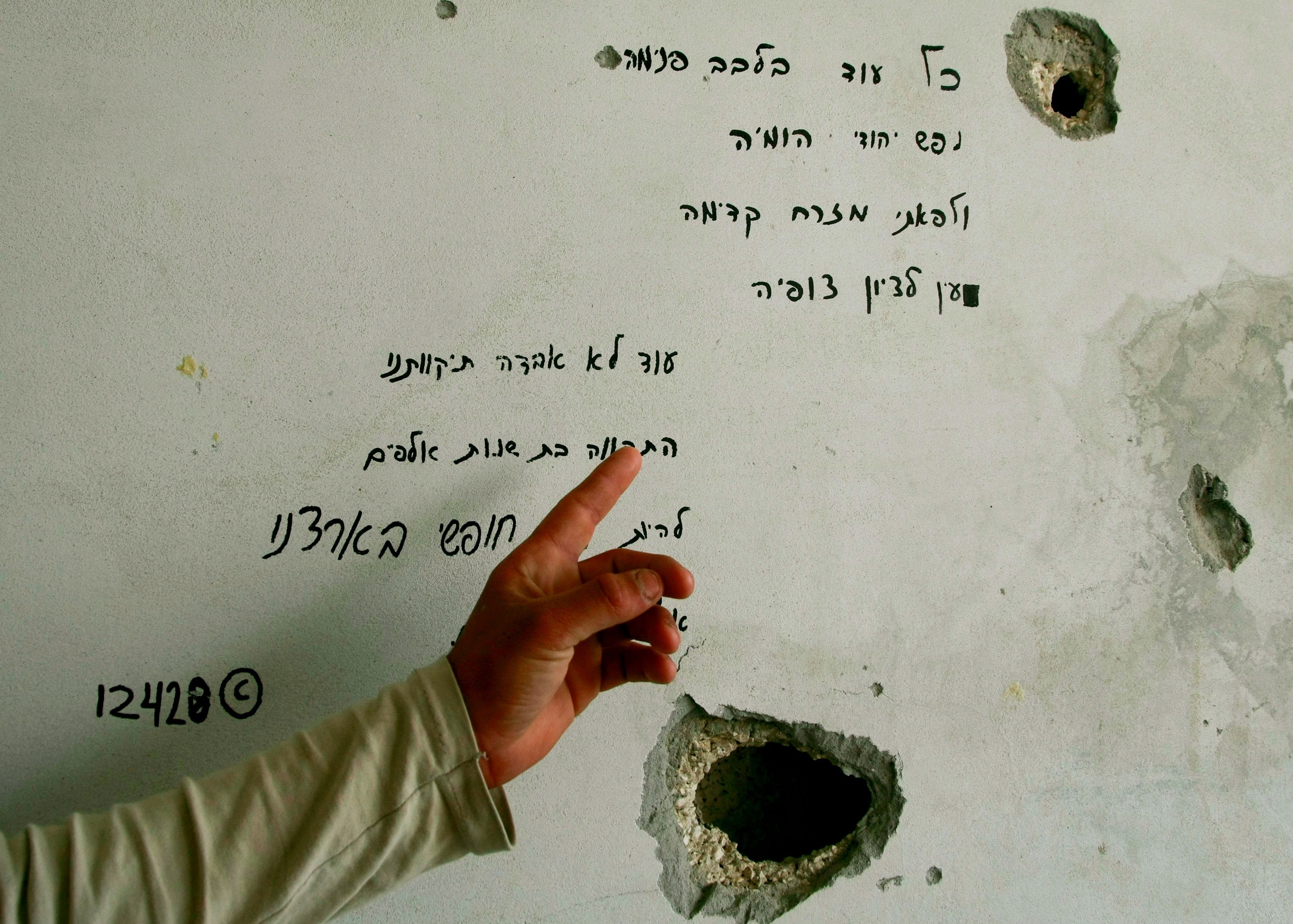
The Hebrew graffiti, apparently left by Israeli soldiers, includes mocking and callous messages. The line being pointed to reads “חוסה לא/הר3ל” (roughly translating to “Shelter no/Har3l”). Other visible inscriptions include references to “rock” and “shelter,” the date “11.12,” the word “chaos,” and what appears to be soldiers’ signatures or unit markers.
The graffiti stands as a stark testament to the dehumanization that accompanies such attacks insensitive scrawls on the walls of a home where an entire family was killed, including an infant, by weapons that burn at over 800 degrees Celsius.
Sunday Morning, 9 am Dublin, 29 March 2026 | 11 am Occupied Jerusalem, Palestine {Palm Sunday in Ireland. In Jerusalem, Israeli police barred Cardinal Pierbattista Pizzaballa, the Latin Patriarch, from entering the Church of the Holy Sepulchre to celebrate Palm Sunday Mass. The first time in history such a restriction has been imposed during this sacred celebration.}
The phone rings twice. The first is thin, metal on glass but the second lingers, a half breath hanging between us. When she answers, her voice comes like steam, warm and slow, and suddenly I am standing in that small kitchen with her even though I am not. A peeler rasps across lemon skin, a yellow ribbon curling into the sink. A spoon drags sugar into a bowl with that slow habitual scrape. Someone shifts and a cupboard door closes with a low thud.
She tells me she peels the lemon to avoid bitterness and the words land heavy like rind on the counter. For a moment the call holds everything ordinary and tender while she gives me the recipe for Kanafeh with lemon, knowing damn well I am the worst baker in the family. She insists, hopeful my next cake will rise fluffier and my pastries less crumbly. She always does this.
Then the line changes, the static scratches at her sentences, a dry hiss eating syllables and turning instructions into fragments. A direction collapses mid word and all I catch is “mix the.” The call dies then returns like breath held and released. Each reconnection feels tentative and each disappearance hits like a small violence. When the sound comes back it is brittle, her voice folding inward as if afraid of too much pressure. She laughs remembering chocolate and coconut. She says “Bounty” like it is some childhood treasure, and the word shines for one second before the noise swallows it whole. She does not remember the boycott list. She might not remember Mars Inc funds Israeli startups. I do not tell her this either. I let her keep the memory of the taste, while I carry the complicity.
Use the solar panel for the blender, she says. Do not drain the battery. I picture those panels on the rooftop, coaxed into giving power only when the sun feels generous. In Gaza kitchens keep time by sunlight now, and recipes are scheduled around whatever electricity they get. This small practical thing opens the larger arithmetic of survival and I feel it tighten in my chest. My aunt forgot I was exiled, she forgot that i live here with grid power and running water, missing every loved one executed by the Israeli occupation. I live with a tight noose of guilt. I do not tell her I have constant electricity and i let her believe I am still counting sun hours with her. It is okay to lie during genocide.
Her grandchildren call out in the background, small voices threading through everything. She tells them to wait, the single word carries both care and exhaustion. Between instructions she hides a cough inside the sentence like it might break the fragile normal we built on this line.
The call keeps fragmenting, with each break leaving a small emptiness.
I have spent the years of genocide thinking about why I write while listening to her breathe through the static. Why I still live when colleagues are killed doing the same work. People who kept filming when the camera itself became a target. Their names come to me like a list that must be spoken so they are not erased.
Ali Shoeib, Fatima Ftouni and Mohamed Ftouni. Israel killed them all yesterday. The Israeli occupation army confirmed the strike. They named only Ali Shoeib and called him a terrorist, offering no evidence. They stayed silent about Fatima and Mohamed, as if erasing two names could make the crime smaller.
I put the phone down before I say everything I want to say. The room here stays quiet. Lemon zest waiting in an unreachable bowl and recipes, cough, missing pills, names of the dead, small kitchen rituals, all of it coexists in the same thin space on the line. The call ends like a match blown out, I hold the phone until the screen goes dark.
Leaving something unsaid or uncorrected is not a lie. It is a necessary kindness in these times.
Drawing heartache with words 💔 Hoping for a gentler tomorrow 🙏🏻