

You’ve seen the video already, and it doesn’t ask for interpretation. In broad daylight, on a public street that looks like any other, a Black woman is met by ICE agents who close in, pull her hands behind her back, and secure the cuffs with the ease of people who expect compliance, not questions. There is no border here, no checkpoint, no visible reason that needs to be offered, only force unfolding in the open, carried out with the confidence of a system that assumes this will pass without consequence.
The identity of the woman in the footage has not been independently verified, and she is not Nasra Ahmed, the Somali American U.S. citizen whose detention and injuries were reported in Minnesota. What matters, though, is not the name but the mechanics. This is what ICE enforcement looks like when it enters ordinary life, stripped of policy language, legal euphemisms, and courtroom distance.
And it doesn’t stop with adults.
In Minnesota this month, ICE agents detained a five-year-old child and his father as they arrived home from preschool. The child was taken along with his father and transferred hundreds of miles away, despite the family having an active immigration case and no criminal charges. School officials said agents used the child to pressure family members and described the impact as terrifying for students and parents alike. A superintendent asked the obvious question out loud, why is a five-year-old being detained.

This is not enforcement gone wrong. This is enforcement doing exactly what it is allowed to do.
What connects a woman cuffed on a sidewalk and a child used as a bait after preschool is not error or confusion. It is infrastructure, funding, contracts and a system designed to operate with impunity and without consequence.
ICE is not just an agency. It is an ecosystem.
If you want to boycott ICE, you boycott the companies that make this possible.
Who Profits From ICE
This is not theoretical. These companies are named because they make money from detention, surveillance, deportation, and the infrastructure that allows ICE to function at scale.
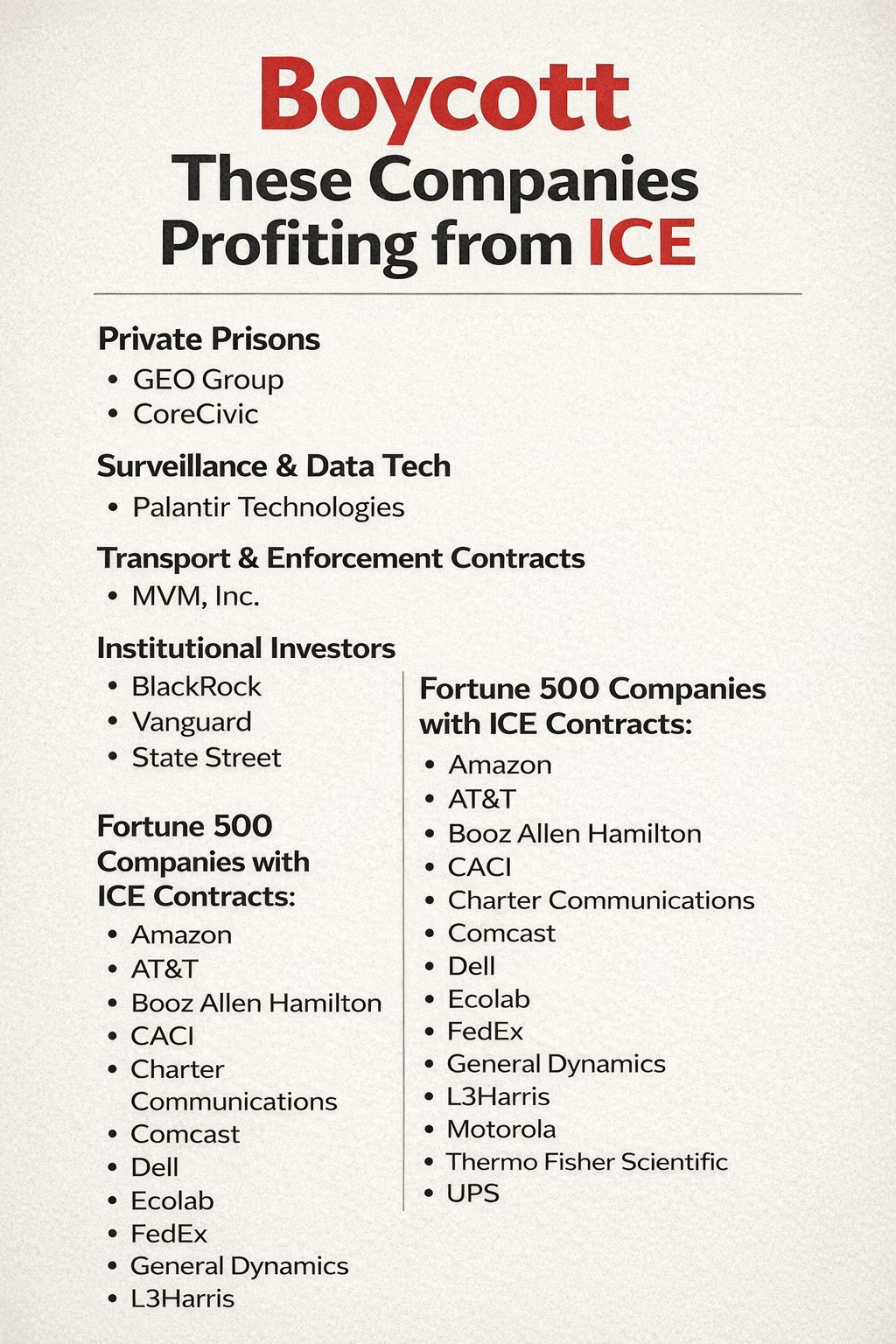
Private prison corporations
They are paid per detainee, per bed, per night, so detention is their business model.
Surveillance and data technology
ICE does not “find” people by accident. It uses software to track, flag, and map lives long before an agent ever steps onto a sidewalk.
This is where Gaza enters the picture, not as metaphor, but as method.
The same surveillance logic used by ICE, mass data collection, predictive targeting, network mapping, was refined through decades of monitoring Palestinians under occupation. Gaza, in particular, has been treated as a testing ground for population control technologies, where entire communities are turned into data sets and risk profiles.
Palantir Technologies sits squarely in this pipeline. The company provides data analytics tools used by ICE, while openly aligning itself with military and security operations elsewhere. These systems are designed to do one thing well, collapse human life into coordinates, relationships, probabilities.
This is the digital infrastructure that comes before arrests, before raids, before cuffs.
What you see on a sidewalk in the U.S. is not separate from what has been normalized in Gaza. Borders are where these technologies are perfected. Other people’s lives are where they are stress-tested. Once proven effective, they travel.
Transport and enforcement contractors
Detention and deportation require logistics. Movement is outsourced and monetized.
This is how removal becomes a service.
Institutional investors
This system survives because it is profitable to capital.
These firms sit at the center of it, financing ICE linked detention and surveillance while also investing heavily in weapons, defense, and tech companies tied to Israel’s war machine and the genocide in Gaza. The same capital moves through borders, prisons, and bombardment. Different sites, one system.
Fortune 500 companies with ICE contracts
Infrastructure, logistics, communications, consulting, and hardware.
Amazon
AT&T
Booz Allen Hamilton
CACI
Charter Communications
Comcast
Dell
Ecolab
FedEx
General Dynamics
L3Harris
Motorola
Thermo Fisher Scientific
UPS
If ICE relies on them to function, they are part of what must be boycotted.
What Boycotting Actually Looks Like
If you have a pension, a retirement account, or a workplace plan, your money is likely invested through firms that hold shares in detention, surveillance, and ICE contractors. You don’t need to understand finance to intervene here, you just need to ask: do you invest in GEO Group, CoreCivic, Palantir, or companies that contract with ICE, and if so, can I opt out or move my money. That question creates a record, and records matter.
Naming matters. These companies rely on staying invisible, and naming them calmly and consistently strips those contracts of cover.
If you work in tech, logistics, finance, or security, ask internally whether your tools or services support ICE or DHS. Many of these contracts survive simply because no one wants to look too closely at them.
Push institutions where you already have access, schools, nonprofits, religious institutions, unions, city councils. Institutions move money faster than individuals, and when they move, contracts get reviewed.
Boycotting ICE is not only about money. It also means refusing to normalize a system that depends on violence becoming routine. That includes denying ICE presence and partnerships in public and professional spaces, no recruitment, no panels, no legitimacy laundering, and refusing forgetfulness by documenting cases and returning to the same companies instead of chasing the next headline. Enforcement slows when cooperation dries up.
Another part of boycotting ICE is refusing the debate altogether. Not arguing whether they had grounds, not litigating paperwork, not entertaining the fiction that this is a good-faith institution. Denying ICE legitimacy means denying it access to “common sense.” You do not debate terror. You name it, isolate it, and withdraw cooperation.
Now what?
A woman handcuffed on a sidewalk and a child detained after preschool are not anomalies or errors. They are the predictable outcomes of a system built to move quickly, operate without accountability, and treat human lives as manageable risks.
ICE does not need belief, debate, or the benefit of the doubt. It knows the harm it causes and continues because it is funded to do so.
What sustains this system is money, contracts, and corporate partnerships that allow violence to be administered as routine procedure.
Boycotts disrupt that flow. They make violence expensive, partnerships uncomfortable, and silence harder to maintain. They expose the machinery behind enforcement and force corporations to reckon with what they enable.
ICE is criminal, and so is the economy that sustains it. The companies that profit from this system rely on invisibility and public quiet to survive.
Silence is a choice and money is leverage.
May the money dry up before another body is taken, and may our refusal be louder than their force.


